- Blog
- How to Import a Car to Lithuania
How to Import a Car to Lithuania
Find out how to import a car to Lithuania as a business. See the key documents, taxes, fees, and registration steps for importing used cars.
Importing used cars to Lithuania and reselling them can be a profitable business. The best part is that the import process can be easy, too.
And when you know how to estimate the import costs, it becomes much easier to check whether a deal will still be worth it once the car reaches Lithuania.
To help you prepare, we’ll show you the main steps, documents, and taxes to keep in mind when importing a car to Lithuania as a business.
Documentation for importing a vehicle to Lithuania as a business
Here’s an overview of documents you’ll need to prepare for each used car you import.
Vehicle purchase invoice
A vehicle purchase invoice is an official document that confirms the sale of the car and shows the key details of the transaction.
The invoice should contain the seller’s and buyer’s information, the vehicle’s details, the sale date, the purchase price, and the VAT scheme that was used (standard or margin).
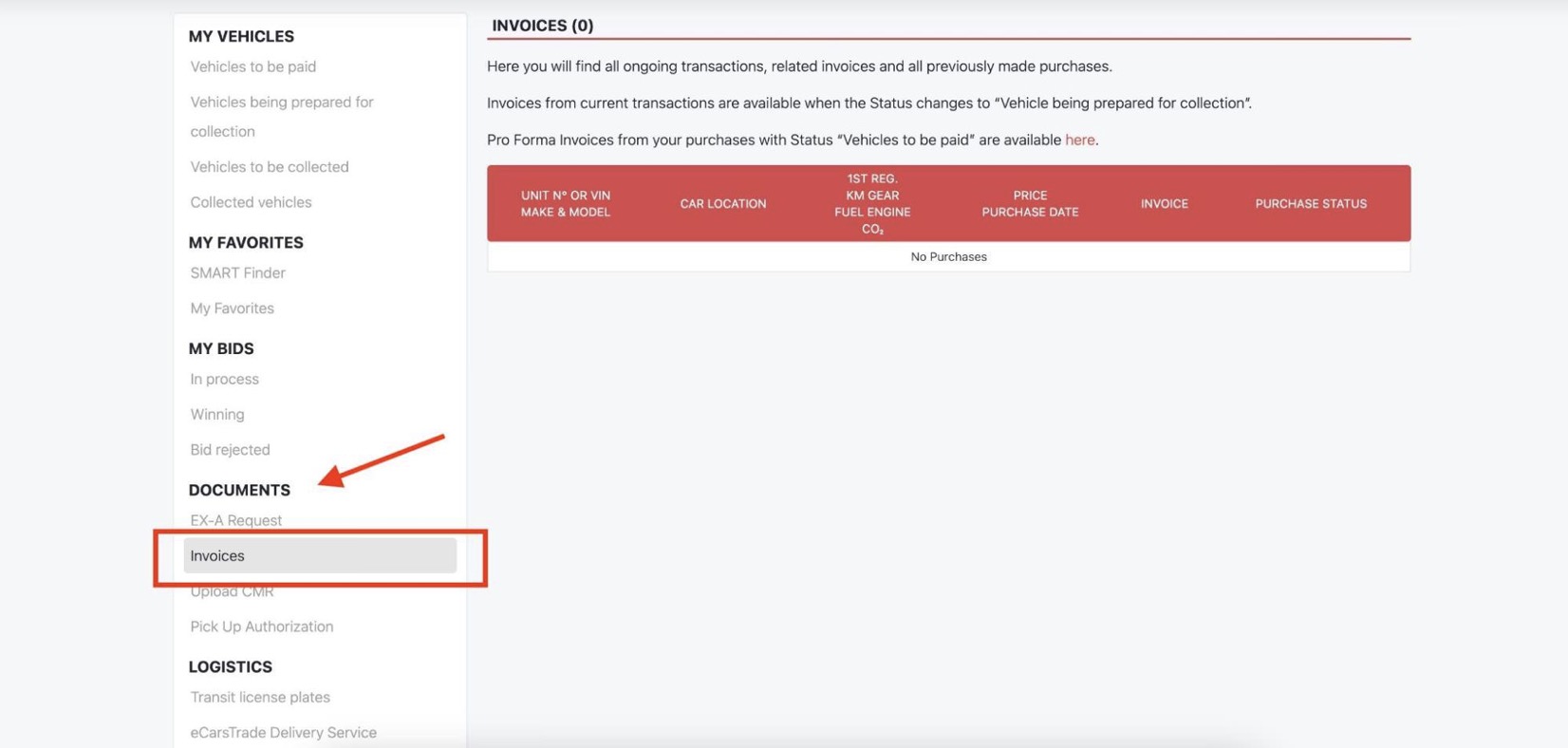
When buying through eCarsTrade, you’ll be able to access your invoice through your Personal page.
Original registration papers
Next, you’ll need the car’s original registration papers to identify the vehicle and to complete registration.
The original registration papers show that the vehicle was previously registered and contain key details like VIN and technical specifications.
All cars sold on eCarsTrade come with their original registration documents.
Certificate of Conformity (for non-EU imports)
When importing cars from other EU countries, you usually won’t need a Certificate of Conformity (COC).
That’s because the key details about the vehicle are already included in the registration papers.
But if you’re importing vehicles from outside the EU, you may need to provide a Certificate of Conformity to show that the car meets the technical requirements for registration in Lithuania.
Since most used cars are sold without the COC, you may need to buy a copy from a provider like EUROCOC for non-EU imports.
Regitra, Lithuania’s state vehicle registration authority, may also accept alternative documents instead of a COC, depending on the car and the documents available.
SDK declaration code
In Lithuania, imported vehicles need an SDK code before registration.
SDK stands for Savininko deklaravimo kodas, or owner declaration code, and it’s used for declaring and tracking vehicle ownership.
You have to obtain the SDK before you import the car to Lithuania, and you can apply for it online through Regitra or at a Regitra branch.
Taxes when importing a car to Lithuania
When estimating how much it costs to import a car to Lithuania, it helps to calculate the three main taxes first.
► VAT
When buying and importing used cars, VAT depends on where the car comes from first.
If you buy a used car from another EU country, the VAT treatment depends on the VAT scheme shown on the invoice.
Within the EU, there are two common VAT schemes for used cars.
The first is the standard VAT scheme. In that case, on eCarsTrade these vehicles are marked as “VAT deductible.”
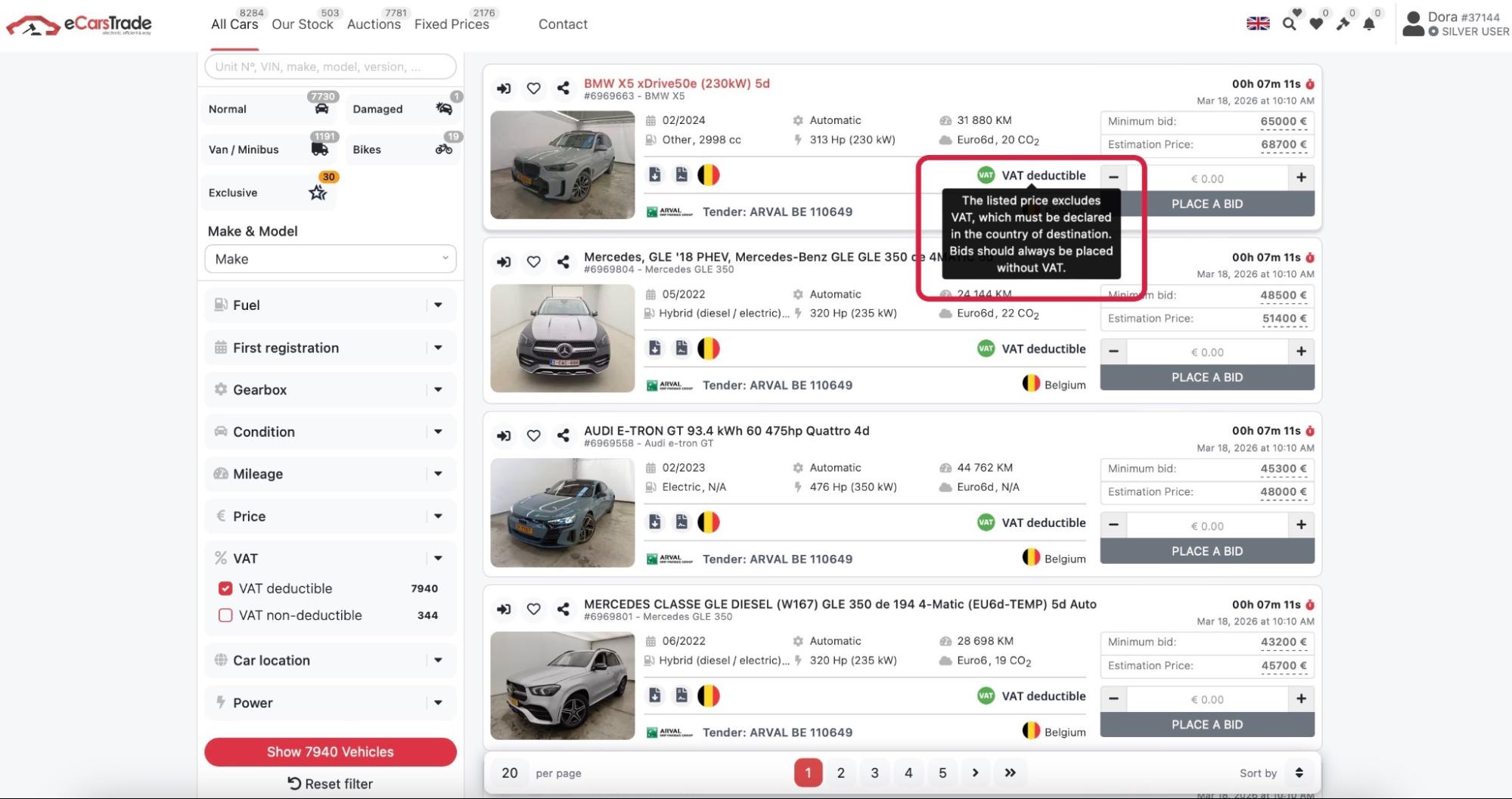
If you buy such a car from another EU member state, it will usually need to report VAT in Lithuania under intra-EU acquisition rules. Lithuania’s standard VAT rate is 21%.
The second option is the margin scheme.
In that case, VAT is applied only to the seller’s margin, and on eCarsTrade these vehicles are marked “Margin - VAT not deductible.”
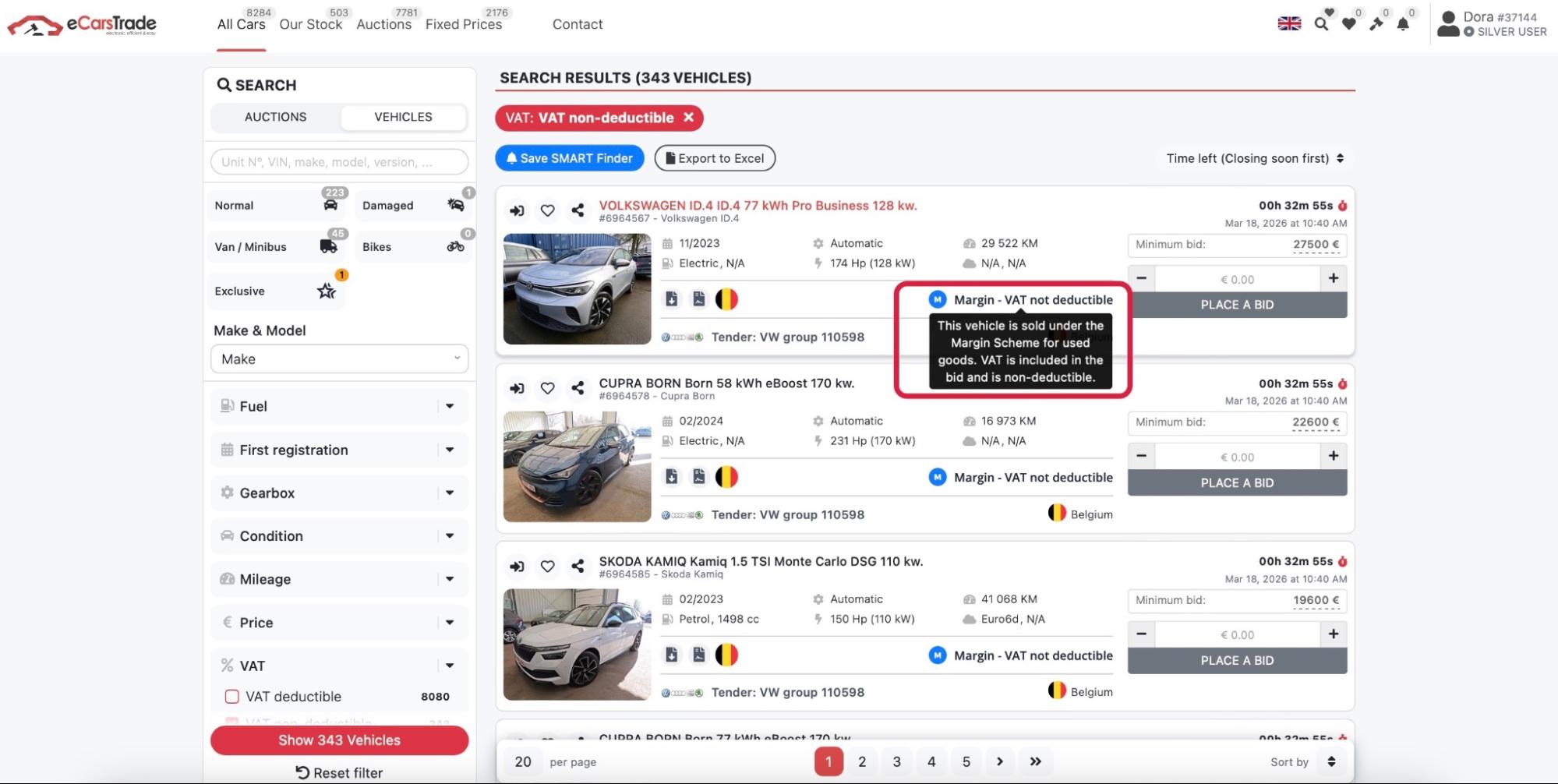
If you buy a used car from another EU country under the margin scheme, you generally do not report Lithuanian VAT on that EU purchase.
If you import a car from outside the EU, the situation is different.
In that case, you usually pay import VAT in Lithuania, regardless of whether the vehicle was sold under a standard VAT scheme or the margin scheme.
So, when checking a car before you buy it, always look at the country of origin and the VAT scheme on the invoice, because both will affect your final cost.
► Customs duty
If you buy a used car from another EU country, you don't pay customs duty in Lithuania because goods moving between EU member states are not subject to import customs duty.
If you’re importing a car from outside the EU, customs duty may apply.
Since the exact rate depends on the vehicle and its customs classification, it’s best to check the applicable rate in the EU TARIC database.
► Vehicle registration tax
Another cost to keep in mind is the vehicle registration tax.
In Lithuania, this tax applies to passenger cars and LCVs with CO₂ emissions above 130 g/km.
The amount depends mainly on the car’s CO₂ emissions and fuel type.
You can use the official Regitra calculator to get an estimate of the registration tax.
You don’t have to pay this tax for EVs, since their CO₂ emissions are zero.
Step-by-step process - from purchasing a car to importing it to Lithuania
You’ll now see the entire process of importing a used car to Lithuania, from buying the car efficiently to registering it.
1. Select and buy the car
If you want to choose from a broad range of vehicles at one place, online car auctions can be a practical way to source cars for import.
Platforms like eCarsTrade let you browse stock from different European countries and use filters to narrow down the search by brand, model, VAT status, and more.
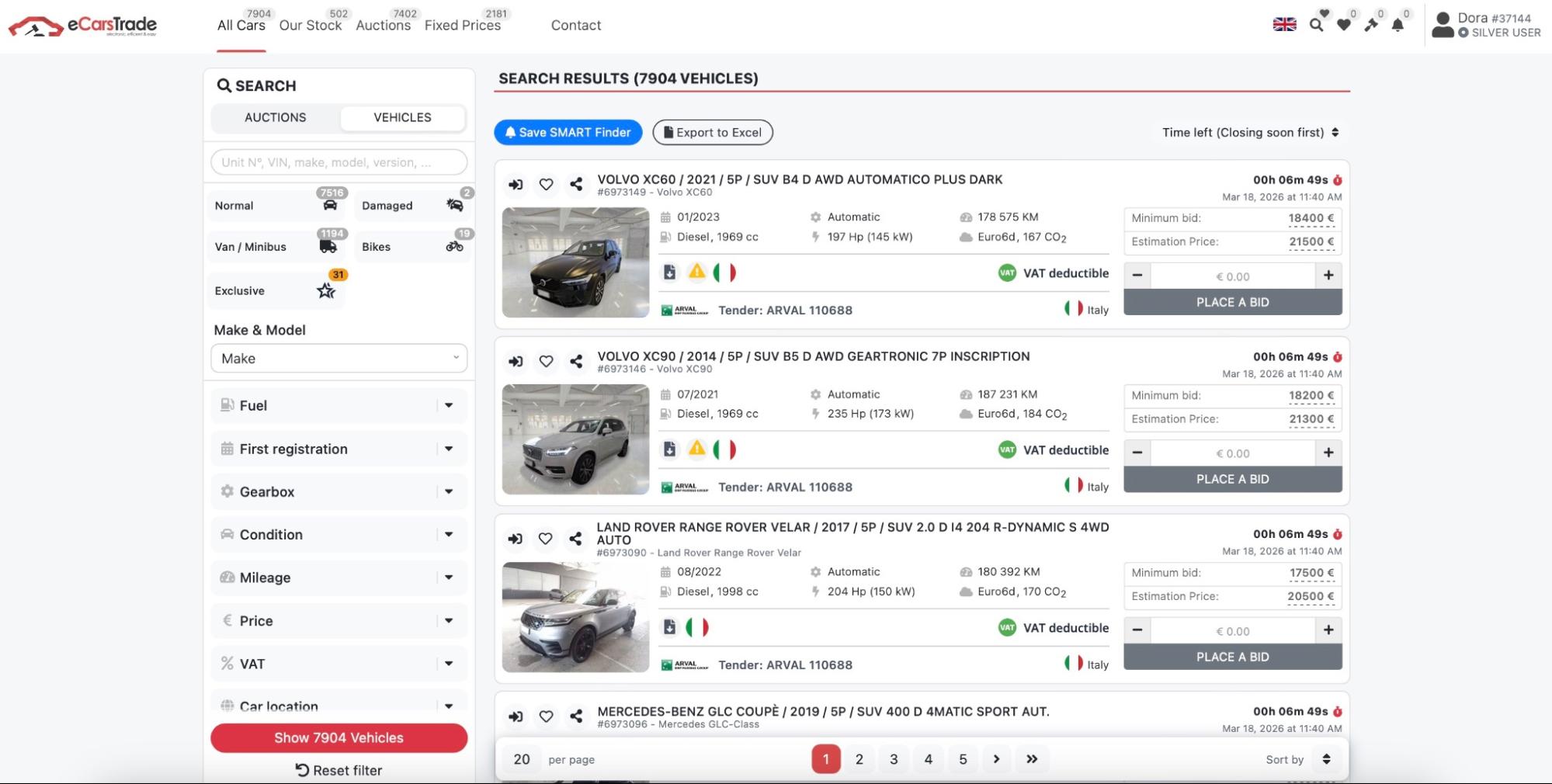
When you’ve found a car that suits your dealership’s needs, you can buy it through the platform.
You’ll receive your vehicle purchase invoice, which is the first document you’ll need for import.
2. Arrange transportation
After buying the car, you’ll need to arrange transport to Lithuania.
If you purchase through eCarsTrade, you can also use the eCarsTrade Delivery Service, which makes the transport process easier by handling the logistics for you.
Depending on the car’s location and your preferences, you could also transport the car yourself.
In that case, don’t forget to arrange the necessary insurance and transit plates before moving the vehicle.
3. Prepare the documentation
Now is the time to make sure you have all the main documents ready.
In most cases, these include the vehicle purchase invoice and the original registration papers.
For some non-EU imports, you may need additional documents such as a Certificate of Conformity.
4. Obtain the SDK code before the car enters Lithuania
Before importing the vehicle into Lithuania, you need to declare the purchase and obtain an SDK code.
You can do this by visiting a Regitra branch or online through Regitra’s pages.
Either way, you’ll need to attach the vehicle purchase invoice.
5. Complete customs
If the car comes from outside the EU, you may also need to go through customs.
At this stage, the customs authorities determine how much customs duty applies, and you need to pay it before the car can continue through the import process.
6. Complete the roadworthiness test and get insurance
When you’ve received your SDK code (and settled customs, if applicable), the car can enter Lithuania.
You should then take the car to a roadworthiness test to confirm that it meets the technical requirements for use on Lithuanian roads.
Here's a list of companies that provide roadworthiness test services.
At this step, you’ll also have to obtain compulsory car insurance.
_01JE9WH8CRTMG3B3WDH56WNJHD.png)
7. Register the car
The final step is to register the vehicle at Regitra and pay the vehicle registration tax.
After registration, Regitra issues the registration certificate and number plates.
Get to know the Lithuanian used car market
ACEA states that Lithuania had 1.41 million passenger cars on the road.
The fleet is relatively old, with the average car being 15.2 years old.
This keeps the used car market active, as buyers often look for newer replacements at prices that are still affordable.
Although the number of EVs on Lithuanian roads is increasing, diesel and petrol cars still have the biggest share of the market.
In 2024, petrol cars made up 44.3% of Lithuania’s fleet, and diesel cars accounted for 38.3% of all passenger cars on the road.
So, if you’re still deciding on what type of vehicles to import, ICE cars might be the safest option.
That said, it is still useful to see which new car models sell best in Lithuania, because new registrations can show you what local buyers already know, and what they may later look for on the used market.
In 2024, the best-selling new models in Lithuania included:
- Toyota RAV4
- Toyota Yaris Cross
- Skoda Octavia
- Skoda Kodiaq
- Volkswagen Tiguan
- Toyota C-HR
- Toyota Corolla Cross
- Toyota Corolla
- Nissan Qashqai
- Audi Q5
As you can see, Lithuanian buyers tend to favor practical, well-known SUVs, so that may be something to consider when choosing cars for import.
Importing a car to Lithuania - FAQ
► Do electric cars pay vehicle registration tax in Lithuania?
No. Fully electric cars do not pay the vehicle registration tax, because this tax applies only to passenger cars and light commercial vehicles with CO₂ emissions above 130 g/km.
► Do I need a Certificate of Conformity when importing a car to Lithuania?
Usually not for EU imports, but for some non-EU imports, you may need a COC or another document accepted by Regitra.
► Do I need an SDK code before bringing the car into Lithuania?
Yes. Imported vehicles need an SDK code before registration, and you should obtain it before the car enters Lithuania.
► Do I pay customs duty when importing a car to Lithuania from another EU country?
No. If you buy a used car from another EU country, you do not pay customs duty in Lithuania.
Importul de vehicule din Europa poate fi un proces complex, dar eCarsTrade este aici pentru a-l simplifica. Aflați cum să: